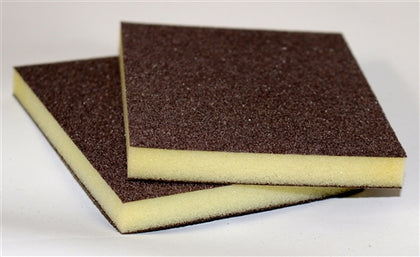
A sanding sponge puts abrasive on a flexible foam core, so it conforms to profiles, eased edges and contours where sandpaper on a block would cut through. In a finishing room they earn their keep on sealer sanding and touch-up: the sponge knocks down raised grain and dust nibs without flattening detail, and it can be rinsed out and reused rather than binned after one panel.
Compared with sheet sandpaper, sponges hold their cut longer, keep a consistent scratch pattern on curved work, and are far easier on hands over a production day. Use them alongside flap wheels for machine work, the sponge handles what the wheel can't reach. Questions on grit sequence? See our application guides or call 1-866-888-5858.
For optimal finishing results, pair our sanding sponges with our sealer sanding machines to achieve professional-grade wood surfaces.
A sanding sponge (or wood sponge) is abrasive grit bonded to a flexible foam core. Where sandpaper creases and skips, the sponge compresses into coves, wraps round-overs, and reaches inside corners with even pressure on every face — which is why finish carpenters keep a pocketful and cabinet shops buy wood sponges 250 pads to a box. Rinse or knock the dust out and they keep cutting; one sponge outlasts a stack of folded sandpaper.
Coarse (60–100) for shaping and paint removal, medium (120–180) for white-wood sanding, fine (220+) for between-coat scuffing. Working profiled doors or mouldings? Sponges handle the corners and details flap wheels can't reach mid-machine — the two together cover the whole door.
For anything not flat, yes — the foam conforms to the shape and spreads pressure evenly, so you don't cut through edges and detail.
Yes — rinse, dry, keep sanding. Wet-or-dry reuse is what makes the per-piece cost so low.
Yes — 250-pad boxes in your choice of grit, which is how production shops buy them.
For larger projects, explore our door sanding machines designed for efficient finishing of flat surfaces.
QuickWood sanding sponges are made with a new adhesive and grit combination that gives them greater cutting power and a longer life span. They feature a non-clogging coating and are waterproof, so you can rinse or knock out the dust and keep sanding. One sponge outlasts a stack of folded sandpaper.
Choose your grit first: coarse (60–100) for shaping or paint removal, medium (120–180) for bare-wood sanding, fine (220+) for between-coat scuffing. Hold the sponge against the surface and let the foam compress into coves, round-overs, and inside corners — it spreads pressure evenly so you avoid cutting through edges or detail. On profiled doors or mouldings, work the sponge into corners the machine cannot reach. When the sponge loads up, rinse it out, let it dry, and continue.
Yes — each sponge has abrasives on both sides, which extends usable life and makes them practical for production finishing work.