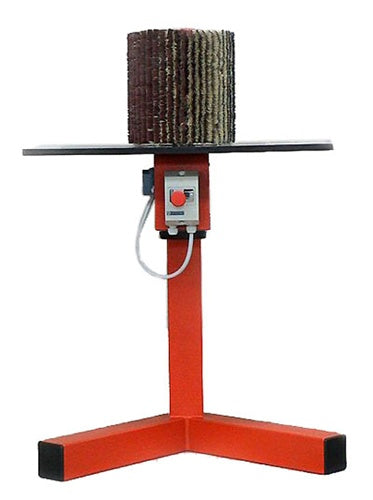
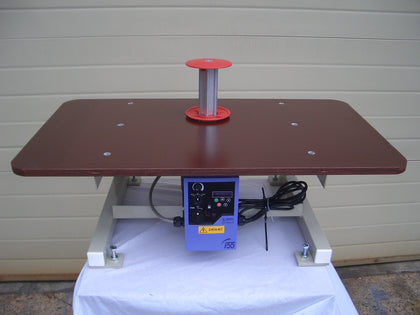
A table sander puts brush sanding at the bench: the abrasive spins in a fixed head and you bring the part to it. For small parts, edges, chair components, turnings and one-off work, that is faster and safer than clamping each piece for a hand-held tool — both hands stay on the workpiece, and the fixed 900 rpm head gives every part the same cut.
The 12" flap wheel table sander runs a full-width flap wheel at a fixed 900 rpm — the sweet spot where abrasive flaps cut cleanly on wood without burning or fuzzing softwoods. It takes the same 12" wheels as our floor machines, so grits swap in minutes and one bench station can go from 120-grit knockdown to 320-grit final denib by changing the wheel. The QTT1 table-mounted spindle sander presents the abrasive vertically instead: the spindle format reaches inside curves, cutouts and edge profiles that a horizontal wheel cannot address square-on.
Choose the flap wheel table sander when the work is faces, edges and outside curves: cabinet parts, shelf fronts, small doors, sanding between coats. Choose the QTT1 when the work is inside radii and openings: handholds, scrollwork, template-routed cutouts. Shops doing both kinds of parts typically run both — the two stations together cover nearly everything that is too small or too varied to justify a pass-through machine.
Benchtop brush sanding follows the same sequence as machine sanding: coarse only as coarse as the defect requires, then step through without skipping more than one grit. For raw hardwood coming off the saw or router, 120 or 150 opens the sequence; for denibbing sealer or waterborne finish, start at 240 or finer and let the flap tips do the work. Light contact always beats pressure — leaning into a flap wheel folds the flaps and polishes instead of cutting.
Both machines run standard QuickWood abrasives: flap wheels in every grit for the table sander, and replacement flaps when a wheel is worn but the hub is good. A cleaning stick pulls resin and finish load out of the abrasive and roughly doubles wheel life on resinous woods.
A fixed 900 rpm — chosen for wood. It is fast enough for real stock removal with coarse wheels and slow enough that fine-grit wheels denib finish without burn.
Yes — wheels change in minutes, and many shops keep two or three dressed wheels beside the bench and swap through the sequence rather than dedicating a machine per grit.
Both earn their spot: the flap wheel station for legs, rails, seats and outside curves, the QTT1 for inside curves and cutouts. If you must pick one first, match it to the majority of your parts and ask us — describe the parts and we will point you at the right station.